

'/%3E%3C/svg%3E)

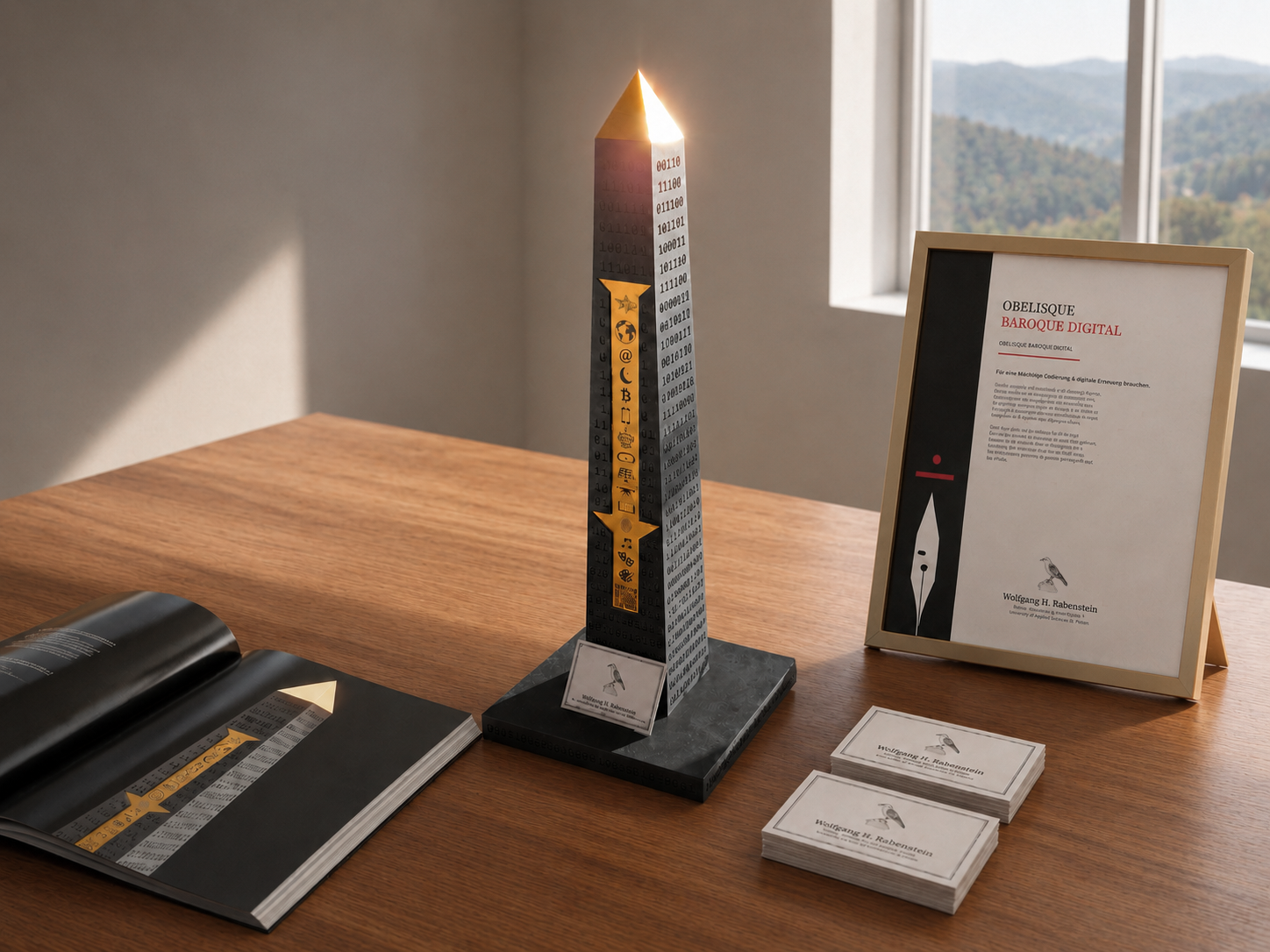
The Obélisque baroque digital came into being as part of my master’s thesis at USTP St. Pölten, embedded within the interdisciplinary project GöttwAIg – Wunderkammer(21), a collaboration between the University for Continuing Education Krems, the KunstDruck association, and Göttweig Abbey, in whose baroque Wunderkammer the work finds its place — a place where, from time immemorial, not only wonders of nature but also quiet reminders of our own transience have been gathered. At the very beginning stood a question that has accompanied me for years now: What remains? Or, put another way: how long do the things we entrust, day after day, with our data — and at times our most precious memories — really last: images on a USB stick, archives on a server somewhere in a cloud — whose exact location we do not know?
Out of this question grew the centerpiece of my work — an obelisk 3D-printed from PLA plastic, bearing a gilded plaque — a flirtation with eternity, with the oldest man-made objects known to us — into whose surface symbols of the present have been engraved, symbols future generations are welcome to decode. This physical specimen points, by means of a QR code, to its digital likeness. This counterpart — programmed by me in vvvv and hosted off-chain — disintegrates into dust before the viewers’ eyes over the course of the entire exhibition: a memento mori that claims immortality while continually dissolving.
The real turning point, however, only revealed itself to me in the inversion underlying this construction: for the 3D-printed counterpart, which passes itself off as biodegradable, will outlive us by centuries as toxic microplastic. The QR code engraved into it belongs to this lie as well — this double lie — for it falls silent in precisely the moment a server, a camera, electricity, or decryption software happens to be missing.
This irresolvability I did not want to resolve, but to deliberately let stand. The Obélisque baroque digital therefore seeks to offer less of an answer than room for interpretation — a pause before the question of what remains.